
SEO is changing. But I don’t think it’s disappearing.
For a long time, SEO had a fairly simple starting point.
Someone needed something.
They opened Google.
They searched for it.
They clicked a website.
That website tried to turn the visitor into a customer.
Of course, there has always been much more to SEO than that. Keywords, content, technical SEO, backlinks, search intent, internal linking and user experience all play a role.
But the basic journey was still familiar:
Search → Results → Click → Website
Now that journey is becoming much less predictable.
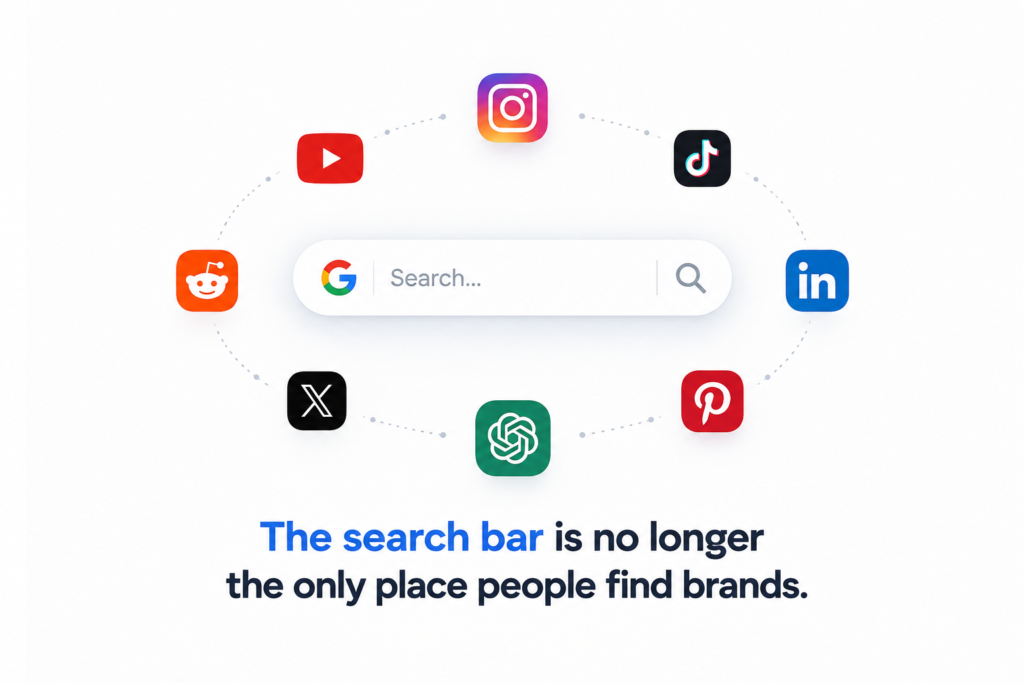
People are searching on social platforms. They’re asking questions directly to AI tools. They’re watching videos before visiting a website. They’re checking Reddit discussions for real experiences.
And sometimes, they may get the information they need without clicking a traditional search result at all.
So this raises an interesting question:
If search is changing, what are we actually optimizing for now?
Search Is Becoming More Than Google
Google Search is still a huge part of how people find information online.
But it isn’t the only place where discovery happens anymore.
Think about how people behave today.
Someone looking for a restaurant might discover it through Instagram.
Someone researching a product might watch YouTube reviews.
Someone looking for honest opinions might search Reddit.
Someone trying to understand a complicated topic might ask ChatGPT, Gemini or another AI system.
And someone ready to compare options might still turn to Google.
The platform changes depending on the question.
This is why I think the traditional definition of search is becoming too narrow.
Search is no longer just a search engine.
It is becoming an experience spread across multiple platforms.
And marketers need to pay attention to that.
Then AI Changed the Search Experience
The biggest shift, in my opinion, isn’t simply that AI can generate text.
It’s that AI is changing how people interact with information.
Instead of typing a few keywords into Google and opening several pages, a person can now ask a much more detailed question and receive a conversational answer.
Google has been adding AI-powered experiences to Search, while tools such as ChatGPT and other AI search products have made conversational discovery much more familiar.
That creates a different kind of visibility.
Your website might still receive the click.
But your brand could also become part of an AI-generated answer, a comparison, a recommendation or a summary.
And that changes what being “visible” online can mean.
The Click Isn’t the Whole Story Anymore
This is probably the part of AI search that interests me the most.
Traditional SEO has always placed a lot of attention on traffic.
How many people visited?
How many keywords are ranking?
What’s the click-through rate?
Those numbers still matter.
But imagine someone asks an AI tool:
“What are some good tools for managing social media content?”
The person might receive several suggestions without immediately clicking through to every company mentioned.
The brand has still been discovered.
There was still a marketing touchpoint.
There just wasn’t necessarily a traditional organic click.
That’s an important distinction.
It doesn’t mean website traffic suddenly doesn’t matter.
It means marketers may need to think about visibility beyond the click.
So, What Should We Optimize For?
This is where I think SEO becomes more interesting.
Instead of asking only:
“How do I rank this page?”
I’d also ask:
“Would this page be useful enough for someone to trust, reference or recommend?”
That changes how you approach content.
You start caring more about whether your website actually demonstrates knowledge.
You care about whether the information is clear.
You care about whether your claims can be supported.
You care about whether your content provides something that isn’t just a slightly rewritten version of the first ten results.
And you care about whether people can understand who is behind the content.
In other words, the fundamentals still matter.
Good content still matters.
Technical SEO still matters.
Search intent still matters.
Internal linking still matters.
Page experience still matters.
But the reason behind those things becomes bigger than simply chasing a position on a results page.
SEO After Google: What Does Search Optimization Actually Mean in the AI Era?
Originality Is Becoming More Important
This is where I think the explosion of AI-generated content creates an interesting problem.
Producing content is easier than it used to be.
You can generate an outline in seconds.
You can create a draft in minutes.
You can rewrite the same idea in ten different ways.
But if everyone can produce content faster, producing more content isn’t necessarily a competitive advantage.
What becomes valuable is having something worth saying.
Your own experience.
Your own examples.
Your own analysis.
A useful observation that someone else hasn’t already repeated a hundred times.
That’s especially important for personal brands and businesses trying to establish authority.
AI can help with the process.
But the thinking still needs to come from somewhere.
Social Media Is Part of Discovery Too
There’s another change that I think SEO professionals shouldn’t ignore.
People are increasingly using social platforms as discovery tools.
Instagram isn’t just somewhere to post photos.
YouTube isn’t just somewhere to upload videos.
Reddit isn’t just an online discussion platform.
Each can become part of someone’s research process.
A person might discover a product through an Instagram Reel, watch a YouTube review, read Reddit discussions and then search the brand on Google.
From the marketer’s perspective, those aren’t completely separate journeys.
They’re different parts of the same journey.
That’s why I don’t think SEO, social media and content marketing should operate in completely separate boxes.
They can feed into each other.
What Happens to Traditional SEO?
I don’t think SEO becomes irrelevant because of AI.
If anything, the job becomes broader.
Traditional SEO asks:
Can search engines find, understand and rank my content?
The next version of SEO increasingly asks:
Can people and AI systems understand what my brand is, what I know, and why my information is worth trusting?
Those aren’t completely different questions.
They’re connected.
A technically broken website still has a problem.
Poor content is still poor content.
A page that doesn’t satisfy search intent is still unlikely to be useful.
And a website with no clear expertise or value doesn’t suddenly become authoritative because an AI search engine exists.
The fundamentals haven’t disappeared.
The environment around them has changed.
I Think the Future Is More About Discoverability
Maybe that’s a better word for where SEO is heading.
Discoverability.
Not just ranking on Google.
Not just getting website traffic.
But making sure your brand can be found, understood and remembered across the places where your audience is actually looking.
That could mean:
Google Search
AI search
YouTube
Your website
Industry websites and communities
And probably other platforms we haven’t even started talking about yet.
The exact platforms will change.
The underlying idea probably won’t.
People will always need answers.
They’ll just keep changing where they look for them.
For businesses that want to build that kind of online visibility, working with a best freelance digital marketer in Thrissur can be one way to bring SEO, websites, content and digital marketing together instead of treating them as completely separate pieces.
My Takeaway
I don’t think the future of SEO is about choosing between Google and AI.
And I don’t think marketers should abandon traditional SEO every time a new search experience appears.
Instead, I think we’re moving toward a broader version of search optimization.
One where content quality, technical foundations, brand authority, original thinking and discoverability all work together.
The search result is only one part of the journey now.
And if people are discovering brands through search engines, social platforms, communities and AI systems, then optimizing for just one of those places doesn’t make much sense.
SEO isn’t disappearing.
The definition of search is getting bigger.
And I think that’s what marketers should really be paying attention to.